
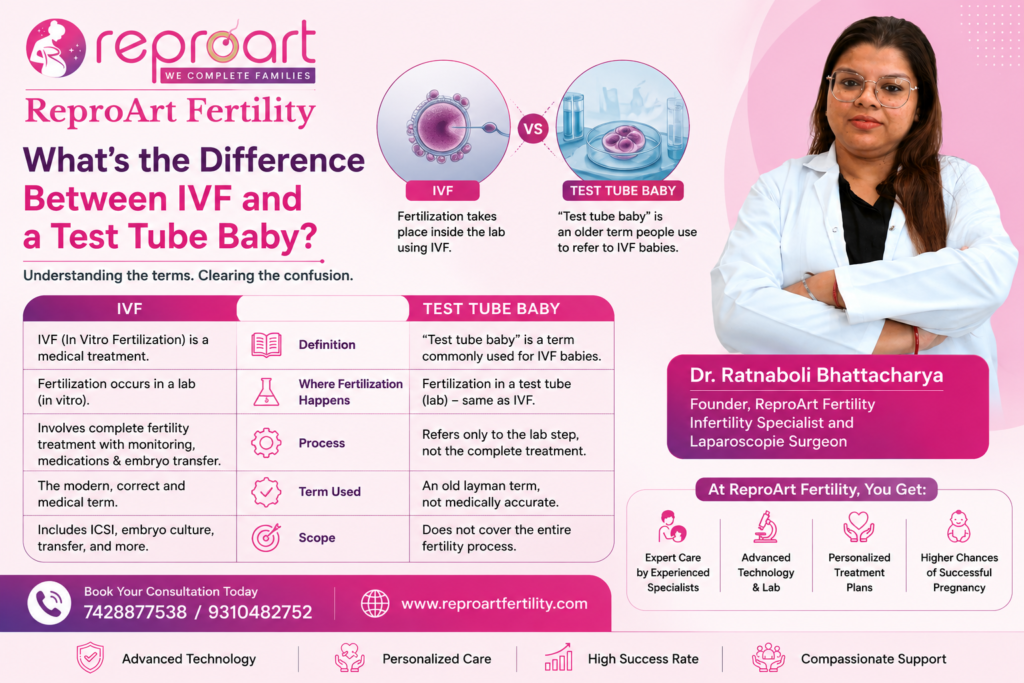
If you are exploring fertility treatment options, you may have come across the terms IVF and test tube baby. Many people assume they are two different procedures, but that is not true. In reality, a test tube baby is simply a baby conceived through In Vitro Fertilization (IVF). At ReproArt Fertility, a leading IVF Centre in Noida, we often meet couples who are confused about these terms. Understanding the difference can help you make informed decisions about your fertility journey and reduce unnecessary anxiety.
Understanding IVF
IVF (In Vitro Fertilization) is one of the most advanced and successful assisted reproductive technologies (ART). In this process, a woman’s eggs are retrieved from her ovaries and fertilized with sperm in a highly controlled laboratory environment. Once fertilization occurs, the resulting embryo is carefully monitored for several days before being transferred into the uterus, where it can implant and develop into a healthy pregnancy.
The term “in vitro” means “in glass,” referring to the laboratory environment where fertilization takes place. However, modern IVF laboratories use sophisticated incubators and advanced culture systems—not actual test tubes.
What Does “Test Tube Baby” Mean?
The phrase “test tube baby” was popularized after the birth of the world’s first IVF baby, Louise Brown, in 1978. At that time, people used the term to describe babies conceived through laboratory-assisted fertilization.
Today, the phrase is considered outdated because embryos are not grown inside test tubes. Instead, fertilization and embryo development occur in specialized culture dishes and incubators that mimic the natural conditions of the human body.
Therefore, there is no medical difference between IVF and a test tube baby. IVF is the treatment, while a test tube baby is the outcome of that treatment.
How Does IVF Treatment Work?
The IVF process involves several carefully planned steps:
- Ovarian Stimulation: Fertility medications help produce multiple mature eggs.
- Egg Retrieval: Eggs are collected using a minimally invasive procedure.
- Sperm Collection: A semen sample is collected from the male partner.
- Fertilization: Eggs and sperm are combined in the laboratory. In some cases, ICSI is performed to inject a single sperm directly into the egg.
- Embryo Culture: Embryos are monitored for 3–5 days in advanced incubators.
- Embryo Transfer: A healthy embryo is transferred into the uterus.
- Pregnancy Test: Blood tests confirm pregnancy approximately two weeks later.
An experienced IVF Doctor in Noida carefully evaluates each couple before recommending the most suitable treatment plan. Factors such as age, ovarian reserve, sperm quality, previous pregnancy history, and underlying medical conditions are considered to maximize the chances of success.
Are IVF Babies Different from Naturally Conceived Babies?
One of the biggest myths is that IVF babies are somehow different from naturally conceived babies.
The truth is that IVF babies are just as healthy as naturally conceived babies. The only difference is how fertilization occurs. Instead of meeting naturally inside the fallopian tube, the egg and sperm are brought together in a laboratory before the embryo is transferred into the uterus.
Once implantation occurs, pregnancy progresses naturally. The baby’s growth, development, and delivery are similar to any other pregnancy.
Who May Need IVF?
IVF may be recommended for couples facing:
- Blocked or damaged fallopian tubes
- Severe male infertility
- Ovulation disorders
- Endometriosis
- Low ovarian reserve
- Unexplained infertility
- Multiple failed IUI cycles
- Advanced maternal age
- Genetic conditions requiring embryo screening
Every couple’s fertility journey is unique, so treatment recommendations should always be personalized.
Why Is IVF So Successful Today?
Modern IVF has improved significantly over the past few decades because of advances in reproductive medicine.
Today’s IVF success rates have increased due to:
- Advanced embryology laboratories
- Time-lapse embryo monitoring
- Blastocyst culture
- ICSI technology
- Laser-assisted hatching
- Genetic testing (PGT)
- Personalized ovarian stimulation protocols
- Improved embryo freezing (vitrification)
These technologies help fertility specialists select healthier embryos and improve pregnancy outcomes.
Common Myths About IVF and Test Tube Babies
Myth 1: IVF and Test Tube Baby are Different Treatments
Fact: They refer to the same fertility treatment.
Myth 2: IVF Babies Are Not Healthy
Fact: Research shows IVF babies generally develop just like naturally conceived children.
Myth 3: IVF Guarantees Pregnancy
Fact: IVF significantly improves pregnancy chances but cannot guarantee success. Factors such as age, egg quality, sperm health, and embryo quality all influence the outcome.
Myth 4: IVF Is Only for Women
Fact: Male infertility contributes to nearly half of infertility cases, making evaluation of both partners equally important.
Why Choose ReproArt Fertility?
Choosing the right fertility center plays an important role in your treatment journey. At ReproArt Fertility, we combine advanced reproductive technology with compassionate, patient-focused care to provide personalized fertility solutions.
Our experienced fertility specialists, skilled embryologists, modern IVF laboratory, advanced operation theatre, and dedicated patient support team ensure that every couple receives individualized treatment based on their medical needs. We believe in transparent communication, ethical treatment practices, and evidence-based fertility care that gives patients confidence throughout their journey to parenthood.
Final Thoughts
There is no difference between IVF and a test tube baby. IVF is the medical procedure used to achieve fertilization outside the body, while the term “test tube baby” simply refers to a baby born through IVF treatment. Understanding this distinction helps eliminate common myths and allows couples to approach fertility treatment with greater confidence.
If you are planning to start your parenthood journey or have questions about fertility treatment, consult the specialists at ReproArt Fertility, a trusted IVF Clinic in Noida. With advanced fertility technology, experienced doctors, and personalized care, we are committed to helping couples achieve their dream of building a family.