
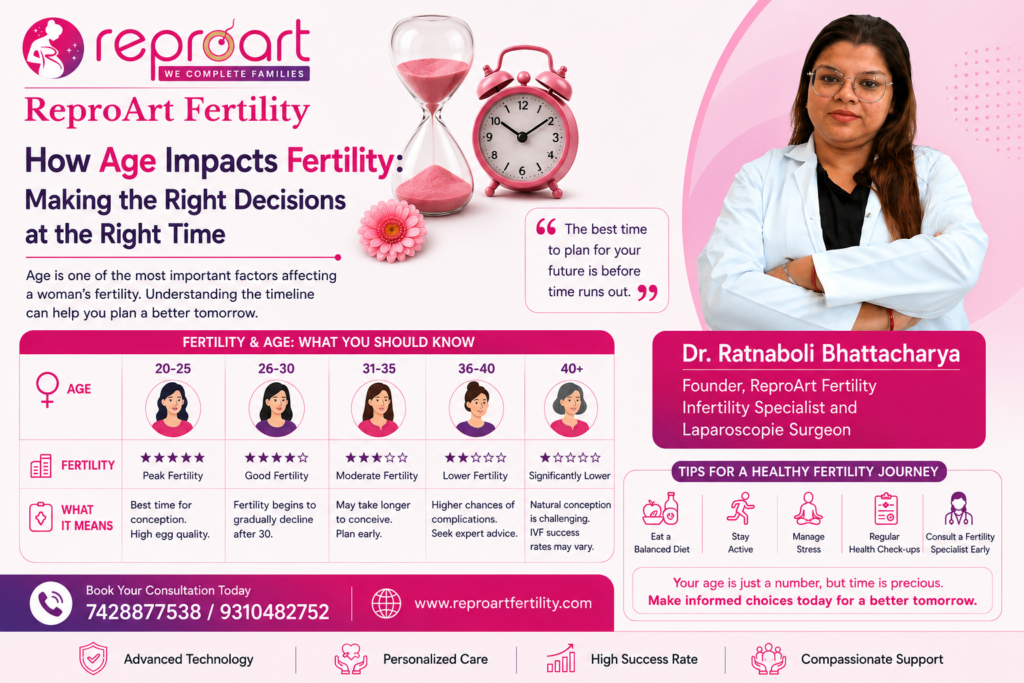
Across the population, women younger than 35 and men younger than 40 have a better chance of having a child than older adults. ‘AGE’ often ‘just a number’ brings with it its own implications. Many may argue and cite examples of someone who had a healthy baby in their late 30s or 40s. However, there is often an unseen side that breaks the bubble – the IVF clinic in Noida.
Case: A woman aged 38, male 43, enters one of the best IVF and Fertility Centre in Noida, after years of struggle to conceive. They expressed that their late marriage was due to professional stability, and financial reasons caused the delay in parenthood.
This has become common among couples, though there are many who do conceive with medical assistance and deliver healthy babies. The age factor related to infertility cannot be completely eradicated.
How does aging affect fertility?
Getting pregnant becomes a challenge as you get older. It increases the risk of miscarriage and has an increased risk of mental health problems. Although the decline in female fertility is well-established, the effect of age on men is just as significant, even if it tends to be more subtle. The Best IVF and Fertility Centre in Noida explains how:
Women’s fertility declines due to two key factors: age-related changes and pregnancy complications
- Egg Quality: The number of remaining eggs in the ovaries decreases more quickly as a woman ages.
- Egg Quantity: The surviving eggs are significantly more likely to have abnormal chromosomes. By the age of 40, it is estimated that 90% of a woman’s eggs may be chromosomally abnormal.
The other common complications include miscarriage and chromosomal abnormalities in the fetus, gestational diabetes, placenta praevia (when the placenta covers all or part of the cervix, which increases the risk of the placenta detaching), cesarean section, and stillbirth.
In addition to age-related complications, underlying conditions like endometriosis and polycystic ovary syndrome (PCOS) can further impact fertility.
Booking a consultation at a trusted IVF Doctor in Noida thus becomes important for early evaluation and guidance. These risks can be better understood and managed with timely intervention from the Best IVF and Fertility Centre in Noida. They are well-known for providing personalized care and support.
The Often-Overlooked Factor: Male Fertility
Did you know that male fertility begins to decline between the ages of 40 and 45? Yes, sperm quality and motility (the ability to swim toward an egg) decrease. Some studies even suggest that sperm count can start to drop by 1% each year as early as age 20. This results in longer ‘time to pregnancy’, a higher risk of miscarriage, and a slightly higher risk of fetal death.
Furthermore, children born to fathers over the age of 40 are five times more likely to develop autism spectrum disorder and face an increased risk of other mental health conditions, such as schizophrenia.
Navigating Pregnancy Risks with Advancing Age
As age increases, so do the risks associated with pregnancy. For example, the risk of miscarriage is around 10% in the late 20s, but rises to nearly 20% by age 30 and continues to increase over time.
Chromosomal abnormalities, such as Down syndrome, also become more common as egg quality declines. The risk increases from approximately 1 in 1,250 at age 20 to 1 in 294 at age 35, and further to 1 in 86 by age 40.
This is where early medical guidance becomes essential. A reliable IVF Clinic in Noida can help monitor these risks through timely screening and evaluation. With the support of the Best IVF and Fertility Centre in Noida, patients can access advanced prenatal screening and diagnostic tests to better understand and manage both maternal and fetal health.
Empowering Decisions: Fertility Preservation and IVF
Despite these biological challenges, modern medicine provides effective options for those who are not yet prepared to start a family.
• Egg and Embryo Freezing: For women who want to delay having children for career or personal reasons, freezing eggs or embryos is a practical option. Freezing eggs before age 40, ideally in the late 20s or early 30s, preserves the “younger” quality of the eggs for future use.
• In Vitro Fertilization (IVF): IVF is often the most effective treatment for infertility related to age. It involves fertilizing mature eggs with sperm in a lab and then placing the resulting embryo into the uterus.
• Donor Options: For women in their 40s whose own eggs may not be suitable, using eggs from a younger donor can greatly increase the chances of a successful pregnancy, often raising success rates to between 60% and 65%.
Choosing the right path depends on individual goals and medical factors. Consulting a trusted IVF Clinic in Ghaziabad and working closely with the Best IVF and Fertility Centre in Noida can help patients make informed decisions at the right time.