
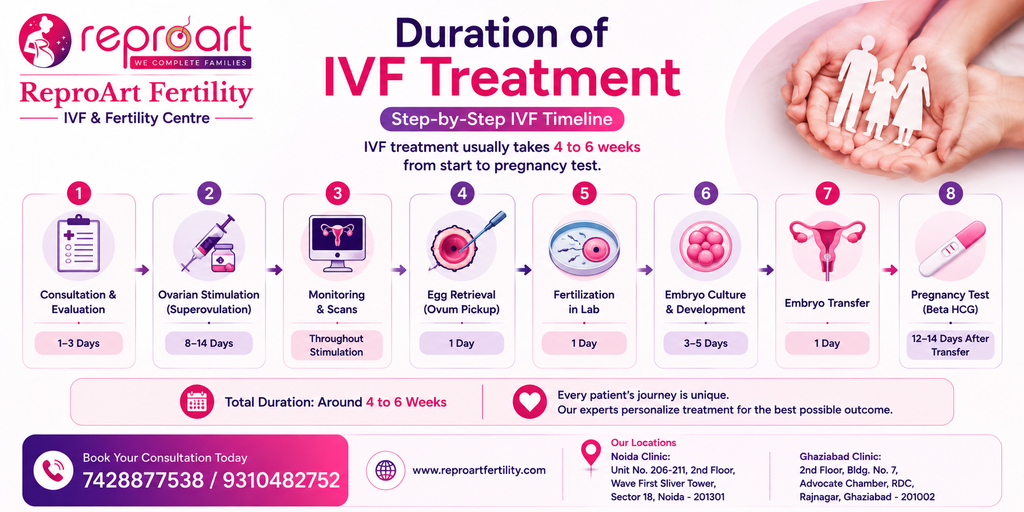
For people who are seeking fertility treatment, one of the very first things that come to mind would be, “How long does the whole IVF treatment last?” The length of an IVF cycle may vary among individuals based on certain factors like ovarian response, treatment cycle used, development of embryos, and other extra tests. Normally, an IVF cycle may take about 3 to 6 weeks, but sometimes the entire process may be longer if some preliminary tests need to be done.
If you are looking for IVF Treatment in Noida, knowing the detailed procedure will give you an idea of how long your entire journey may be.
Step 1: Initial Consultation and Fertility Assessment
The first step in the process of undergoing IVF would generally begin with an in-depth consultation. Your health records as well as your infertility history will be analyzed by the physician and some tests may be prescribed for you as well as for your partner.
Women may have to undergo AMH testing, hormone testing, ultrasound and ovarian reserve test. In men, semen analysis is usually done in order to check the sperm count, motility and morphology.
A skilled IVF Doctor in Noida may examine these results and give a treatment plan according to the fertility record of the couple.
This may take some time ranging from a few days to one or two weeks.
Step 2: Ovarian Stimulation – Around 8 to 12 Days
Once the treatment process starts, fertility medications in injection form are typically administered to help stimulate the ovaries for developing multiple follicles instead of producing just one egg naturally.
While at this stage, it becomes necessary to have frequent monitoring. This is done through ultrasound scanning as well as blood testing from time to time.
The period of stimulation is normally about 8-12 days, although this may differ according to the reaction of the ovaries to the medicine.
In the case of IVF Treatment in Noida, frequent monitoring helps the fertility experts make changes in the medicines if need be and decide on the time of egg collection.
Step 3: Trigger Injection
Trigger injections are administered when the follicles have matured to the right stage in order to facilitate the eggs’ final maturation process.
Egg retrieval usually takes place about 34 to 36 hours following trigger injections. It is very important that patients adhere to the instructions provided by the clinic.
Step 4: Egg Retrieval – About 20 to 30 Minutes
Oocyte retrieval is another term for egg retrieval, which refers to the process where mature eggs are harvested from the ovaries under the guidance of an ultrasound machine.
The egg harvesting procedure takes about 20 to 30 minutes on average, but the entire duration at the clinic can take longer due to preparatory and recovery periods.
On the same day, the male partner is expected to contribute a sperm sample. However, there are instances where frozen or surgically harvested sperm can be utilized.
Step 5: Fertilisation and Embryo Development – 3 to 6 Days
Once the eggs have been retrieved, they are mixed with the sperm in the lab. In each case, either conventional IVF or ICSI will be required.
The embryos will then be monitored until they develop into embryos.
The embryos will normally be observed for several days before reaching the blastocyst stage, which occurs on Day 5 or 6 in some cases. It is possible to freeze these embryos or transfer them according to the treatment plan.
It is important that the embryology lab be involved at this stage of treatment. The patients should speak with their fertility doctor about this.
Step 6: Embryo Transfer
Embryo transfer involves the process of transferring the selected embryo to the uterus.
The embryo transfer process could either happen in the current treatment cycle or in a future frozen embryo transfer cycle depending on the situation of the patient.
In case of a fresh embryo transfer, the process could happen a few days after the egg is retrieved from the patient. But at other times, the doctors might advise for the freezing of the embryos before they are transferred in another treatment cycle.
An IVF Doctor in Noida would be able to tell which form of transfer is the most suitable for you.
Step 7: Pregnancy Test – Around 9 to 14 Days After Transfer
The waiting time after embryo transfer until the patient takes a pregnancy test varies between 9 and 14 days. Beta-hCG is the blood test that is often applied to determine the pregnancy status.
It should be noted that it is necessary not to rely on the home pregnancy test too soon because early testing can be misleading.
How Long Does the Complete IVF Process Take?
An average IVF cycle may last anywhere between 3 to 6 weeks, according to the type of IVF cycle chosen and whether embryo transfer will be done within the current cycle or any other future cycle.
It should be noted that IVF is not a process with a definite duration. There are couples who will have to spend more time conducting tests, undergoing treatments, doing genetic screening, freezing embryos, or preparing for a frozen embryo transfer cycle.
Thus, it would be wiser if IVF Treatment In Noida was considered as a flexible timeline process.
Factors That Can Affect IVF Treatment Duration
Several factors can influence the length of an IVF cycle, including:
- Age and ovarian reserve
- Response to stimulation medicines
- Number and development of follicles
- Sperm quality and fertility factors
- Embryo development
- Need for ICSI or other laboratory procedures
- Genetic testing of embryos, when recommended
- Requirement for a frozen embryo transfer
- Individual medical conditions
- Previous fertility treatment history
Because every couple has a different fertility profile, treatment duration should be discussed during consultation rather than estimated solely from another person’s experience.
Choosing the Right Fertility Specialist
The IVF process is a complex procedure that involves a lot of coordination between the fertility specialist, nursing staff, embryologists, and the patient. Selecting an expert IVF Doctor in Noida will help you learn about each step of the treatment, how long it will take, and which options are available for you in your particular case.
An ideal fertility centre will offer you complete information regarding investigations, drug administration, monitoring, lab work, embryo transfer, and after-care.
If you are going to have IVF Treatment In Noida, it is important to know how long your individual cycle would take from your fertility specialist.
Conclusion
The time frame for undergoing an IVF treatment is different for different individuals. However, while a regular cycle might take between 3 to 6 weeks, the entire process could be shorter or longer than that depending upon the method of treatment and personal fertility requirements.
Knowledge about all the various stages of the process including the consultation session, ovulation stimulation, egg retrieval, embryo cultivation, transfer, and pregnancy test would go a long way in making your IVF experience more manageable.
More importantly, it needs to be understood that IVF is always a personalized approach and not a generalized one. A consultation session with an expert IVF doctor in Noida could prove to be helpful.